If you are a B.Com, BBA, MBA Finance, CFA or CA student, Financial Modeling can be a valuable skill for building a career in finance.
But Financial Modeling is not a job title. It is a practical skill used in several finance roles, including Investment Banking, Equity Research, Valuation, Financial Analysis, FP&A and Corporate Finance.
So, what does a Financial Modeling career path actually look like?
What Does Financial Modeling Mean?
Financial Modeling involves using financial data, assumptions and tools such as Excel to understand a company’s performance and forecast its future.
A financial model can help answer questions like:
- How much could a company earn in the future?
- What is the company worth?
- What happens if revenue increases or costs change?
- Is an investment or project financially viable?
- What could happen after a merger or acquisition?
In simple terms:
Financial Data → Analysis → Forecasting → Financial Model → Business Decision
Career Options After Financial Modeling
Financial Modeling skills can lead to different finance career paths.
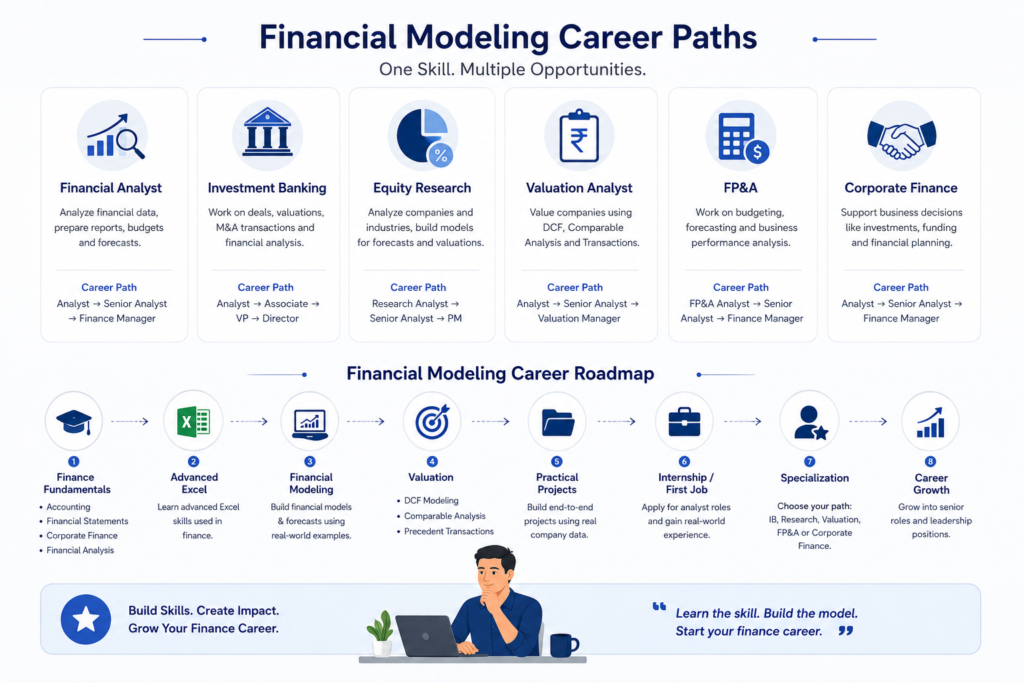
1. Financial Analyst
Financial Analysts work on financial statements, forecasts, budgets, reports and business analysis.
Career path:
Financial Analyst → Senior Analyst → Finance Manager
2. Investment Banking
Investment Banking professionals use Financial Modeling for valuation, M&A transactions and financial analysis.
Career path:
Analyst → Associate → Vice President → Director
3. Equity Research
Equity Research involves analyzing companies, industries and investment opportunities.
Financial Modeling is used for earnings forecasts, valuation and investment analysis.
4. Valuation Analyst
Valuation professionals determine the value of businesses using techniques such as:
- DCF
- Comparable Company Analysis
- Precedent Transactions
5. FP&A
Financial Planning & Analysis (FP&A) professionals work on budgeting, forecasting and business performance.
Career path:
FP&A Analyst → Senior Analyst → Finance Manager
6. Corporate Finance
Corporate Finance professionals support companies with budgeting, investment decisions, forecasting and financial planning.
Which Career Path Is Right for You?
Your choice should depend on your interests.
| You Enjoy | Possible Career |
|---|---|
| Company research | Equity Research |
| Deals & transactions | Investment Banking |
| Numbers & valuation | Valuation |
| Business planning | FP&A |
| Financial analysis | Financial Analyst |
| Business financial decisions | Corporate Finance |
Financial Modeling Career Path for Freshers
If you are a fresher, focus on becoming job-ready rather than trying to master everything at once.
Step 1: Learn Finance Fundamentals
Understand:
- Accounting
- Financial Statements
- Corporate Finance
- Financial Analysis
Step 2: Learn Advanced Excel
Develop practical Excel skills used in finance.
Step 3: Learn Financial Modeling
Practice building:
- Financial forecasts
- Three-statement models
- DCF models
- Valuation models
- Scenario and sensitivity analysis
Step 4: Build Projects
Create models using real company data.
For example:
“Built a 5-year financial forecast and DCF valuation model for an Indian listed company.”
A practical project can demonstrate your ability much better than simply listing “Financial Modeling” on your resume.
Step 5: Apply for Entry-Level Roles
Look for positions such as:
- Financial Analyst
- Valuation Analyst
- Research Analyst
- FP&A Analyst
- Finance Analyst
- Investment Banking Analyst
Skills You Need for a Financial Modeling Career
Financial Modeling alone isn’t enough.
Build a combination of:
Finance Skills
- Accounting
- Financial Analysis
- Corporate Finance
- Valuation
Technical Skills
- Advanced Excel
- Financial Modeling
- PowerPoint
- Data Analysis
Professional Skills
- Communication
- Presentation
- Analytical Thinking
- Attention to Detail
The strongest profile is:
Degree + Finance Knowledge + Technical Skills + Projects + Communication
Financial Modeling After B.Com or MBA Finance
After B.Com
A possible path is:
B.Com → Financial Modeling → Internship/Entry-Level Role → Financial Analyst → Senior Analyst → Manager
After MBA Finance
A possible path is:
MBA Finance → Financial Modeling + Valuation → Finance Role → Analyst/Associate → Manager
Financial Modeling can help bridge the gap between academic finance knowledge and practical application.
Financial Modeling + CFA
CFA and Financial Modeling can complement each other.
Think of it simply:
CFA → Learn and understand finance concepts
Financial Modeling → Apply those concepts practically
For example, CFA may help you understand DCF valuation, while Financial Modeling helps you actually build a DCF model in Excel.
This combination can be useful for careers in:
- Equity Research
- Valuation
- Investment Management
- Investment Banking
- Financial Analysis
How Does a Financial Modeling Career Grow?
Career progression varies by role and company, but a typical journey can look like:
0–2 Years: Analyst / Junior Analyst
2–5 Years: Senior Analyst / Associate
5–8 Years: Manager / VP-level roles
8+ Years: Senior Finance Leadership
Your growth depends on your skills, experience, performance, specialization and company.
Is Financial Modeling a Good Career Option?
Financial Modeling can be a strong career skill if you enjoy:
Finance + Numbers + Analysis + Business + Problem Solving
However, learning Financial Modeling does not automatically guarantee a job.
Your focus should be on developing practical skills, building projects, gaining experience and preparing for finance interviews.
Financial Modeling Career Roadmap
If you’re starting from zero, follow this roadmap:
Finance Fundamentals
↓
Advanced Excel
↓
Financial Modeling
↓
Valuation
↓
Practical Projects
↓
Internship / First Job
↓
Specialization
↓
Career Growth
Final Thoughts
Financial Modeling can open doors to multiple finance careers rather than one specific job.
Whether you want to become a Financial Analyst, Investment Banking Analyst, Equity Research Analyst, Valuation Analyst or FP&A professional, Financial Modeling can be an important technical skill.
The key is not just to learn Financial Modeling, but to practice it, build real models and understand the business behind the numbers.
Learn the skill. Build the model. Start your finance career.