If you are a BCom, BBA or MBA Finance student looking to build a career in finance, learning financial modeling can help you develop practical, industry-relevant skills.
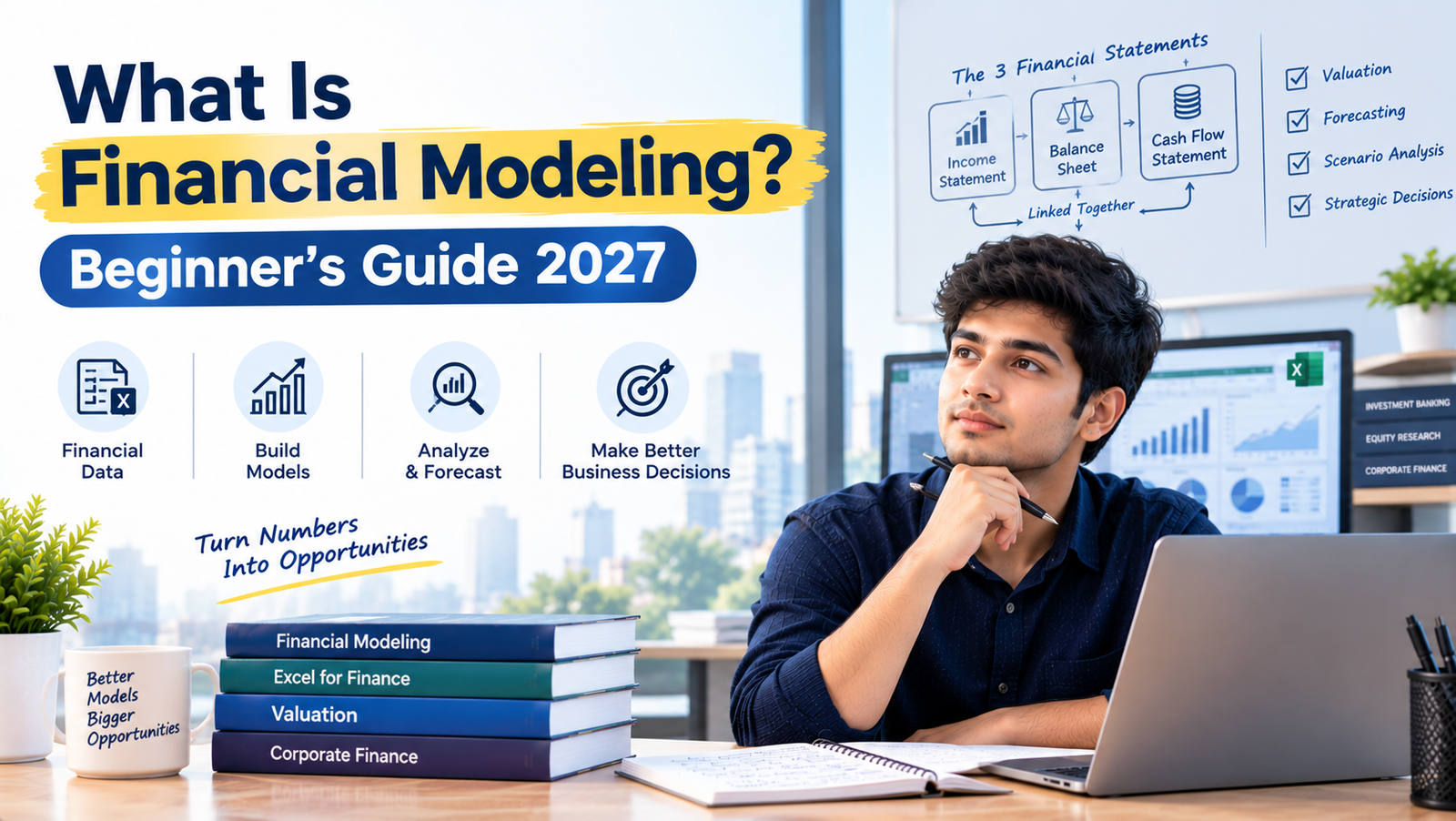
Financial modeling is the process of using financial data, Excel and business assumptions to forecast a company’s financial performance. It helps professionals analyse businesses, estimate valuations and make informed financial decisions.
Why Is Financial Modeling Important?
Financial modeling is widely used in finance for:
- Financial forecasting: Estimate future revenue, expenses and profits.
- Company valuation: Understand business value using valuation methods.
- Investment banking: Support financial analysis and M&A transactions.
- Equity research: Evaluate company performance and investments.
- Budgeting: Plan expenses, cash flows and business targets.
Types of Financial Models
Some commonly used financial models include:
- Three-Statement Model: Connects the income statement, balance sheet and cash flow statement.
- DCF Model: Estimates company value using projected cash flows.
- Comparable Company Analysis: Values a business by comparing it with similar companies.
- M&A Model: Analyses the potential financial impact of a merger or acquisition.
What Skills Are Required for Financial Modeling?
To learn financial modeling, focus on:
- Advanced Excel and spreadsheet formulas
- Accounting and financial statement analysis
- Financial forecasting and budgeting
- Company valuation techniques
- Analytical thinking and attention to detail
You can begin with basic Excel and accounting before progressing to complex models.
Is Financial Modeling a Good Career Option in 2027?
Financial modeling skills can be useful for roles such as Financial Analyst, FP&A Analyst, Valuation Analyst, Equity Research Analyst and Investment Banking Analyst.
Your opportunities depend on your practical skills, education, experience and employer requirements. Building real-world projects can help you demonstrate your abilities during interviews.
Learn Financial Modeling with FinOptions
At FinOptions Institute of Financial Studies, our Financial Modeling program combines practical finance training with Advanced Excel, valuation and Investment Banking concepts.
The program features:
- 450+ hours of learning
- Financial modeling and valuation techniques
- Industry-oriented projects and case studies
- Expert mentoring and interview preparation
- Placement assistance
- Online and offline learning options
Our focus is on helping learners develop practical finance skills alongside theoretical knowledge.
Explore our Financial Modeling Course in Indore to learn more about the curriculum and training options.
Frequently Asked Questions
1. What is financial modeling in simple words?
Financial modeling uses financial data and assumptions to estimate a company’s future performance.
2. Is financial modeling useful for BCom and MBA students?
Yes. It can help students develop practical skills for financial analysis, valuation and forecasting.
3. Is Excel necessary for financial modeling?
Yes. Excel is widely used to build financial models, analyse data and prepare forecasts.
4. What jobs use financial modeling?
Financial Analyst, FP&A Analyst, Valuation Analyst and Investment Banking Analyst are examples of roles where modeling skills may be useful.
5. Where can I learn financial modeling in Indore?
Explore the FinOptions Financial Modeling Course for practical training and career preparation.
Conclusion
Financial modeling combines Excel, accounting and financial analysis to solve real business problems. If you want to build practical finance skills in 2027, structured training and hands-on projects can be a useful starting point.
Build your finance skills with FinOptions.