Every year, thousands of ambitious management students graduate with an MBA in Finance from top universities and institutions across India. Armed with high GPAs and strong conceptual foundations in corporate finance, cost accounting, and portfolio management, most expect to land analytical roles in corporate finance, investment banking, or financial planning & analysis (FP&A).
However, recruitment drives reveal a stark reality: academic excellence alone no longer guarantees corporate readiness.
When corporate recruiters visit cities like Bangalore, Delhi, Pune and Indore they often find a skill mismatch. While students understand formulas conceptually, few can build a flexible, dynamic 3-statement model from scratch in Excel or run real-time stress testing for business decisions.
To secure high-growth analytical roles today, MBA finance graduates in india must bridge the gap between textbook finance and desk-ready execution.
The Core Disconnect: Theoretical Finance vs. Floor-Ready Execution
Academic finance curricula excel at teaching the concepts. Students learn what Discounted Cash Flow (DCF) is, how weighted average cost of capital (WACC) works, and the definitions of liquidity ratios.
However, on the corporate floor, nobody asks you to write a definition. Managers expect you to:
- Clean messy, unstructured operational data quickly.
- Link dynamic Income Statements, Balance Sheets, and Cash Flow Statements.
- Present dynamic dashboards that show how a 10% inflation spike affects working capital and bottom-line profit.
Without hands-on training, fresh MBAs spend their initial months struggling with basic Excel mechanics rather than contributing strategic insights. This is why corporate hiring teams increasingly prioritize applied technical capability over basic academic transcripts.
3 Pillars Top Recruiters Look For Over Basic Marks
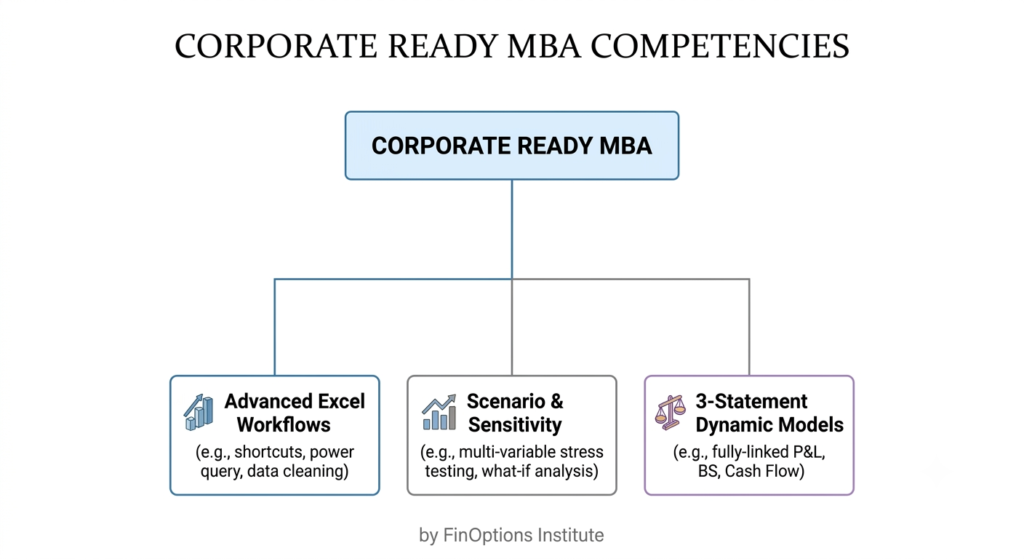
1. Advanced Excel Workflows (Speed, Accuracy & Auditability)
Excel remains the central operating system of corporate finance. Recruiters expect candidates to work efficiently using shortcuts, structured logic, and advanced functions without relying on mouse navigation.
| Basic Academic Competency | Corporate-Level Expectation |
Simple formulas (SUM, AVERAGE, basic VLOOKUP) | Dynamic lookups (INDEX/MATCH, XLOOKUP), nested logical formulas |
| Manual data entry and basic formatting | Dynamic dashboards, Pivot Tables, advanced data aggregation |
| Static spreadsheets with hardcoded values | Audit-ready, structured models built on clear assumption drivers |
2. Scenario Analysis & Sensitivity Modeling
In corporate finance and FP&A, numbers are rarely static. Executive teams constantly ask “what-if” questions: What if raw material costs rise by 15%? What if customer acquisition drops next quarter?
Recruiters seek graduates who understand how to structure Data Tables, Scenario Managers, and Dynamic Drivers. Building dynamic sensitivity matrices allows management to evaluate risk and make proactive decisions.
3. Integrated Financial Projections (Forecasting & Valuation)
Building a standalone revenue forecast in Excel is easy; building an integrated, self-balancing 3-statement model requires true financial logic.
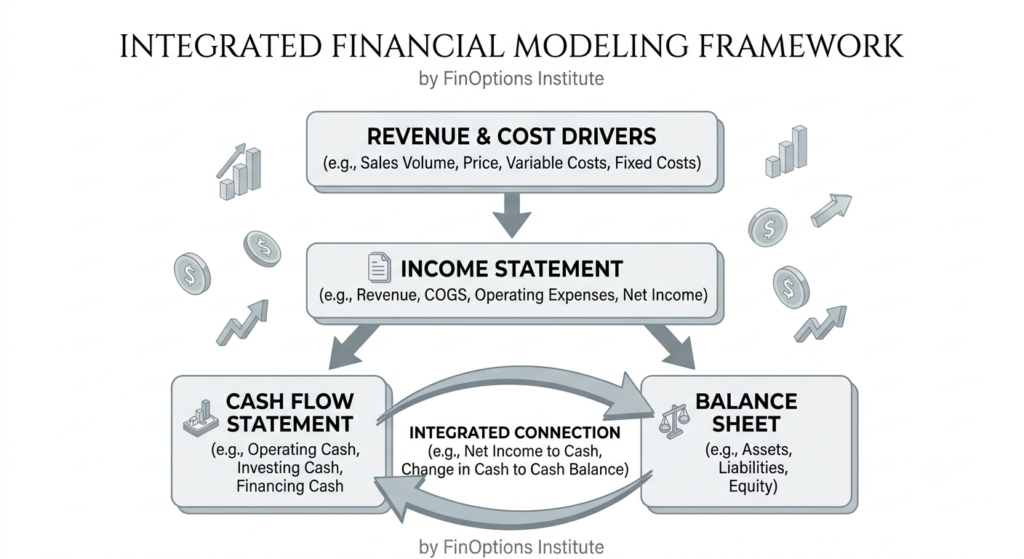
Top employers test whether a candidate can take raw operational assumptions, construct dynamic schedules (like depreciation and debt amortization), and connect all three statements cleanly so the Balance Sheet balances dynamically.
How FinOptions Bridges the MBA-to-Corporate Gap in MP
At FinOptions Institute of Financial Studies, training goes beyond slide presentations to focus on real-world application. The curriculum is structured around industry-standard methodologies to transform academic knowledge into floor-ready execution.
- 450+ Hours of Practical Learning: Hands-on practice using actual corporate data sets, financial filings, and real-company annual reports.
- Integrated 3-Statement & DCF Modeling: Step-by-step guidance on constructing dynamic financial models, revenue projections, DCF valuations, and relative comps.
- FP&A & Analyst Thinking: Focus on the “why” behind the numbers—helping students interpret valuation outputs, identify key business KPIs, and present structured financial insights.
- Placement & Interview Preparation: Mock technical interviews, resume building, and real-world project submissions that prove competency to corporate hiring managers.
High-Growth Career Roles for Skilled MBA Graduates
With practical financial modelling and FP&A skills on your resume, you stand out during campus placements and lateral hiring drives for core roles:
- Financial Planning & Analysis (FP&A) Analyst: Driving budgeting, forecasting, and operational performance tracking.
- Corporate Finance Executive: Evaluating capital expenditures, cost of capital, and investment opportunities.
- Equity Research Associate: Analyzing industry drivers, building company forecasting models, and writing investment reports.
- Valuation & Investment Banking Analyst: Supporting M&A deals, company valuations, and investor pitchbooks.
Upgrade Your Degree with Practical Skills
An MBA in Finance opens the door, but applied modeling skills determine how far you walk through it. By mastering Advanced Excel workflows, scenario analysis, and dynamic financial forecasting, MBA graduates across MP can transform their academic credentials into high-paying, core finance careers.
Explore how the FinOptions Financial Modelling Course can prepare you for top corporate finance roles.
Here is a quick summary of FinOptions’ core programs
- Advanced Excel (AE): Covers dynamic dashboards, complex lookups (
XLOOKUP,INDEX/MATCH), data cleaning, and MIS reporting. Best for building fundamental data and spreadsheet efficiency. - Financial Modelling (FM): Hands-on training in 3-statement models, DCF valuation, revenue forecasting, and scenario analysis. Best for aspiring Financial, FP&A, and Corporate Finance Analysts.
- Investment Banking (IB): Focuses on M&A advisory, pitchbook preparation, transaction comps, and relative valuation. Best for equity research and corporate deal-making roles.
- Chartered Financial Analyst (CFA®): Exam preparation for globally recognized portfolio management, equity research, and asset management careers.
- Financial Risk Manager (FRM®): Training focused on market, credit, and operational risk modeling for banking, treasury, and consulting roles.