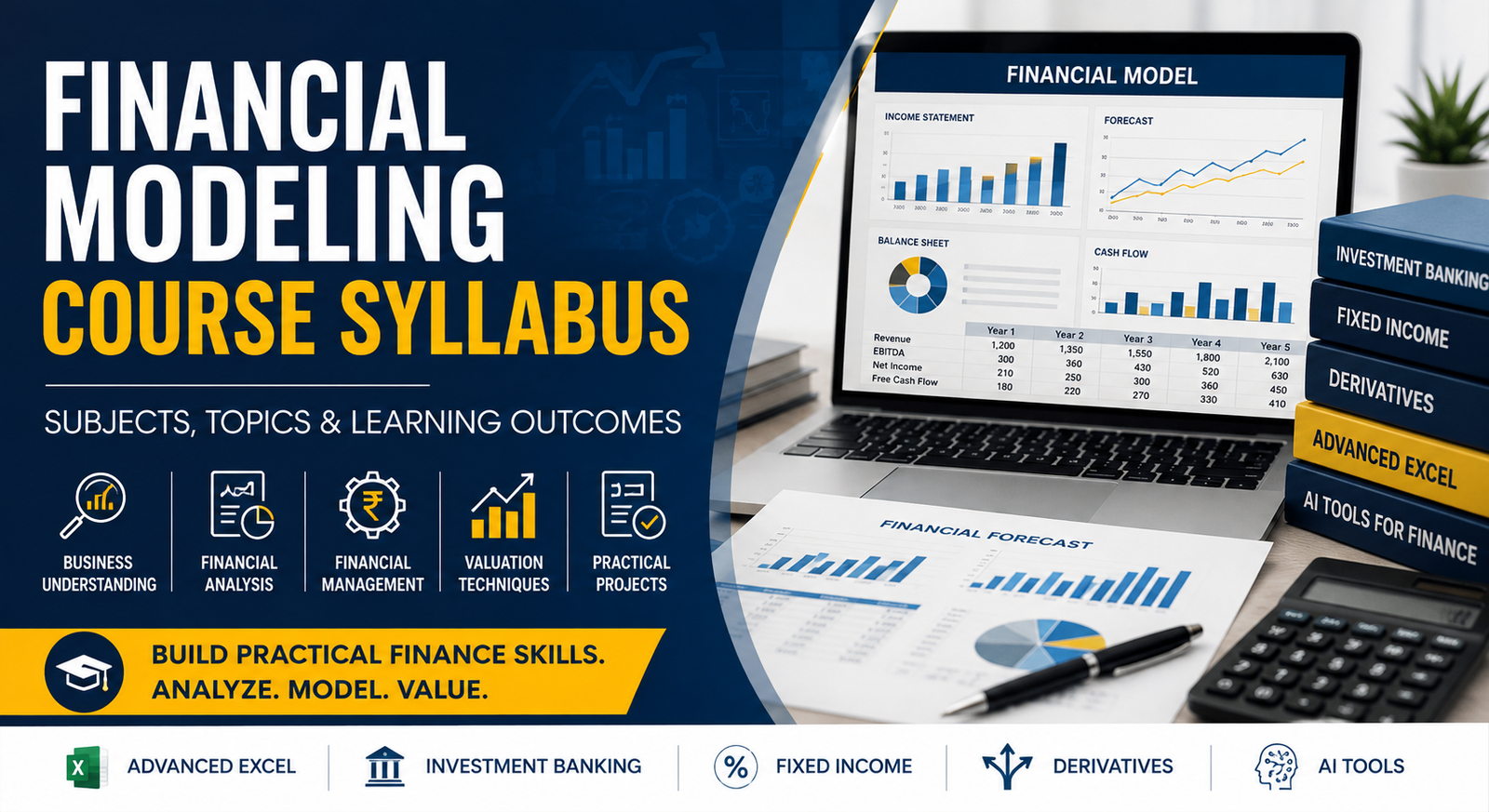
A Financial Modeling Course Syllabus should cover more than just Excel. It should help students understand businesses, analyze financial statements, forecast performance and value companies.
At FinOptions, the Financial Modeling curriculum focuses on practical finance skills through Business Understanding, Financial Understanding, Financial Management, Business Valuation and practical project submissions.
Financial Modeling Course Syllabus
The major subjects covered in the Financial Modeling syllabus include:
1. Business Understanding
Before building a financial model, it is important to understand the business and industry.
Topics include:
- Key Business KPIs
- Market Segmentation
- Key Person Assessment
- Company Overview
- Industry Report
This helps students understand the factors that drive a company’s performance.
2. Financial Understanding
Financial statements form the foundation of Financial Modeling.
This module covers:
- Income Statement
- Balance Sheet
- Cash Flow Statement
- Financial Ratio Analysis
Students learn how to analyze the financial health and performance of a company.
3. Financial Management
This section focuses on important corporate finance concepts.
Key topics include:
- Time Value of Money
- Capital Budgeting
- Cost of Capital
- Risk & Return
- Capital Structure
- Dividend Policy
These concepts help students understand how companies make investment and financing decisions.
4. Business Valuation
Valuation is an important part of a Financial Modeling course.
Students learn how to forecast financial statements using:
- Top-Down Approach
- Bottom-Up Approach
The syllabus also covers company valuation through:
- DCF Valuation
- FCFE
- FCFF
- Relative Valuation
This helps learners understand how analysts estimate the value of a business.
5. Practical Submissions
Financial Modeling is a practical skill, so students should get opportunities to apply what they learn.
The FinOptions curriculum includes:
- Final Financial Model
- Equity Research Report
- Investment Banking Report
These projects help students connect financial concepts with real-world applications.
6. Additional Learning
The Financial Modeling syllabus also includes exposure to additional finance and technology areas:
- Investment Banking
- Fixed Income
- Derivatives
- Advanced Excel
- AI Tools
These skills can help learners understand the wider applications of Financial Modeling in modern finance.
Financial Modeling Course Syllabus at a Glance
| Module | Key Topics |
|---|---|
| Business Understanding | KPIs, Market Segmentation, Company & Industry Analysis |
| Financial Understanding | Income Statement, Balance Sheet, Cash Flow, Ratio Analysis |
| Financial Management | TVM, Capital Budgeting, Cost of Capital, Risk & Return |
| Business Valuation | Forecasting, DCF, FCFE, FCFF, Relative Valuation |
| Practical Projects | Final Model, Equity Research Report, Investment Banking Report |
| Additional Learning | Investment Banking, Fixed Income, Derivatives, Advanced Excel, AI Tools |
Who Should Learn Financial Modeling?
A Financial Modeling course can be useful for:
- B.Com & BBA students
- MBA Finance students
- CFA aspirants
- CA students
- Commerce graduates
- Working professionals
- Finance professionals
It can be particularly useful for careers in Investment Banking, Equity Research, Financial Analysis, Corporate Finance and Valuation.
Why Choose a Practical Financial Modeling Course?
Financial Modeling is not simply about learning Excel formulas.
It combines:
Business Understanding + Financial Analysis + Excel + Forecasting + Valuation
A practical course should therefore give you opportunities to build financial models, analyze companies and prepare professional finance reports.
Financial Modeling Course at FinOptions
FinOptions offers a 450+ hour Financial Modeling program focused on practical finance learning. The curriculum covers Business Understanding, Financial Analysis, Financial Management, Valuation, Advanced Excel, Investment Banking, AI Tools and practical project submissions.
If you’re looking for a Financial Modeling Course in India, understanding the syllabus is the first step toward choosing the right program.
Learn the business. Understand the numbers. Build the model.