A company’s financial statements tell you what happened.
But finance professionals are often asked a much harder question:
“What could happen next?”
What if revenue grows by 15%?
What if costs increase?
Should the company acquire another business?
Is the company actually worth ₹500 crore?
Can it afford to take more debt?
What happens to profits if the economy slows down?
The answers don’t come from looking at one number.
They come from understanding how different financial variables interact — and this is where Financial Modeling comes in.
What Is Financial Modeling?
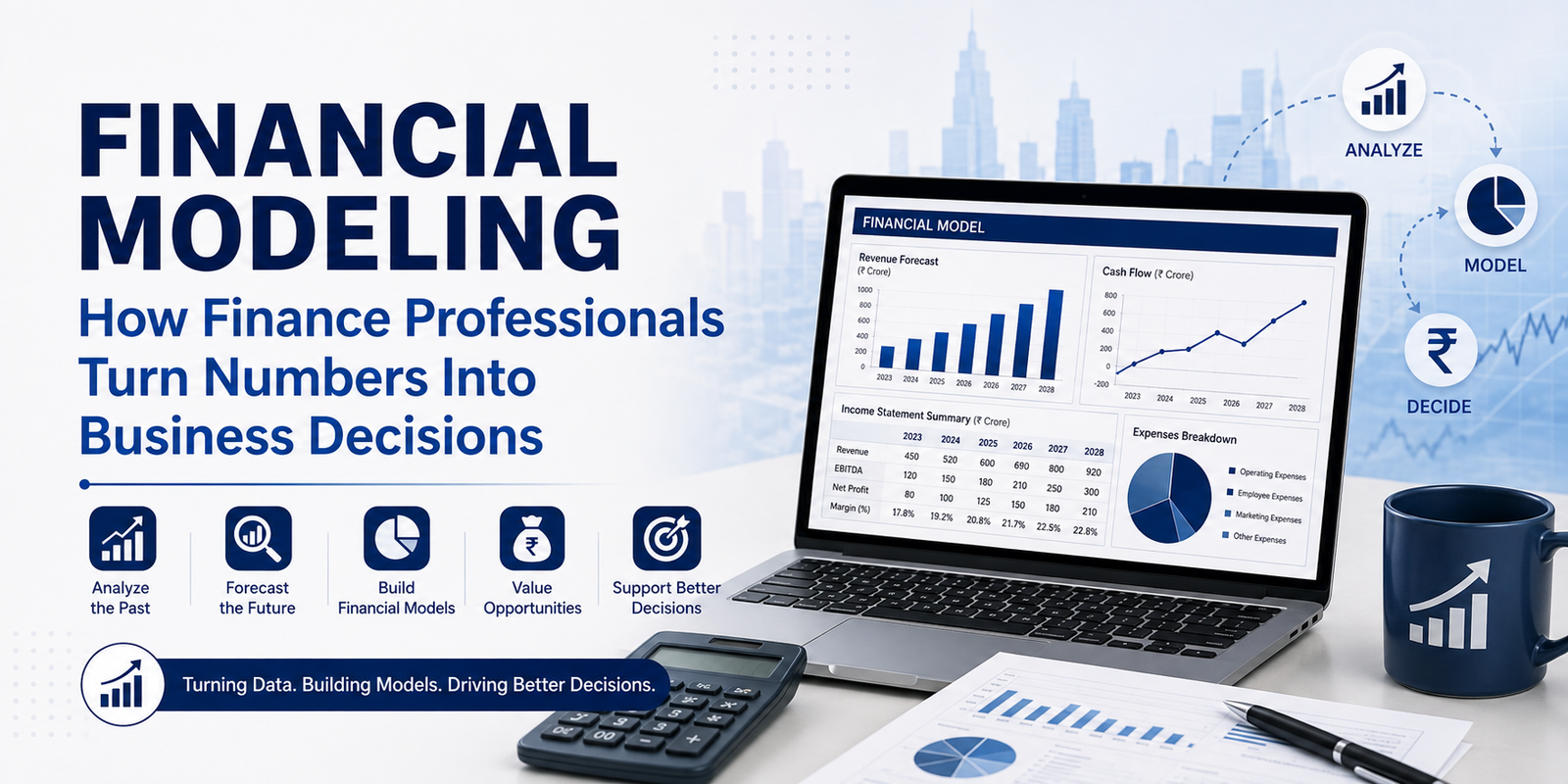
Financial Modeling is the process of building a structured financial representation of a business, usually using Microsoft Excel, to understand its current performance and estimate its future financial position.
Think of a financial model as a virtual version of a business.
You feed it historical financial data, business assumptions and industry information. The model then helps you see how changes in those assumptions could affect revenue, profits, cash flows, valuation and other financial outcomes.
In simple words:
Financial Modeling helps turn business assumptions into numbers that can support better decisions.
Why Do Companies Need Financial Models?
Imagine a company planning to open 20 new stores.
Management wants to know:
- How much investment will be required?
- How much revenue could the stores generate?
- When could the investment be recovered?
- What happens if sales are lower than expected?
- Will the expansion increase profitability?
- Is the project financially viable?
Instead of relying only on intuition, a financial analyst can build a model.
The model can simulate different scenarios and show management the possible financial outcomes.
That’s the real purpose of Financial Modeling:
Not just calculating numbers — but understanding what those numbers mean.
What Does a Financial Model Actually Do?
A typical financial model connects several pieces of a business together.
Historical Data
First, analysts study the company’s past performance:
Revenue → Expenses → Profit → Assets → Liabilities → Cash Flow
This helps identify how the business has performed historically.
Business Assumptions
Next come assumptions about the future.
For example:
- Revenue growth
- Selling prices
- Operating costs
- Employee expenses
- Working capital
- Capital expenditure
- Tax rates
- Debt and interest
These assumptions become the building blocks of the forecast.
Financial Forecast
The model then projects the company’s future financial statements.
You may forecast:
Income Statement + Balance Sheet + Cash Flow Statement
The three statements are connected so that a change in one part of the business can affect the others.
Valuation
Once future cash flows and financial performance are estimated, the model can also help determine what a company may be worth.
This is where techniques such as:
- Discounted Cash Flow (DCF)
- Comparable Company Analysis
- Precedent Transactions
- FCFF / FCFE
come into play.
Where Is Financial Modeling Used?
Financial Modeling isn’t limited to one finance career.
It is used across multiple areas of the financial industry.
Investment Banking
Investment bankers use financial models to evaluate companies, support M&A transactions, prepare valuations and understand the financial impact of deals.
Equity Research
Equity research analysts build models to forecast company earnings, analyze business performance and estimate potential valuations.
Corporate Finance
Companies use financial models for budgeting, forecasting, capital allocation and strategic planning.
FP&A
Financial Planning & Analysis teams use models to compare actual performance with budgets, prepare forecasts and support management decisions.
Valuation
Valuation professionals use models to estimate the value of businesses, projects and assets.
Credit & Risk Analysis
Models can help evaluate debt repayment capacity, cash flows, financial strength and potential risks.
Financial Modeling Is Not Just Excel
This is one of the biggest misconceptions among beginners.
Excel is the tool. Financial thinking is the skill.
Knowing 100 Excel formulas doesn’t automatically make someone a good financial modeler.
A strong financial modeler needs to understand:
Accounting
How the Income Statement, Balance Sheet and Cash Flow Statement work together.
Finance
How businesses generate returns, use capital and create value.
Excel
How to structure, calculate and present a model efficiently.
Business
What actually drives a company’s revenue, costs and profitability.
Valuation
How financial performance and future cash flows translate into business value.
Analytical Thinking
How to question assumptions and interpret the output of a model.
That’s why Financial Modeling sits at the intersection of Accounting + Finance + Excel + Business + Analysis.
A Simple Example of Financial Modeling
Suppose a company currently generates:
₹100 crore Revenue
and management expects revenue to grow by 10% annually.
A financial model doesn’t stop there.
The analyst may ask:
If revenue becomes ₹110 crore:
→ What happens to operating expenses?
→ What happens to EBITDA?
→ How much working capital is required?
→ How much cash will the business generate?
→ Will additional debt be required?
→ What happens to valuation?
Now change the assumption.
What if revenue grows only 5%?
The model can show how the company’s profitability, cash flows and valuation could change.
This is the power of modeling.
You can change an assumption and immediately see its financial impact.
What Do You Learn in Financial Modeling?
A practical Financial Modeling learning journey generally follows this progression:
Step 1 — Excel
Learn to work efficiently with financial data.
↓
Step 2 — Accounting
Understand how financial statements are constructed.
↓
Step 3 — Financial Statement Analysis
Learn to identify trends, ratios and business drivers.
↓
Step 4 — Forecasting
Project revenue, expenses, working capital and cash flows.
↓
Step 5 — Financial Modeling
Connect assumptions and financial statements into an integrated model.
↓
Step 6 — Valuation
Learn how to estimate the value of a business.
↓
Step 7 — Real-World Projects
Apply everything to actual companies and business situations.
This progression is important because you shouldn’t learn modeling as a collection of Excel formulas.
You should learn how to think like a financial analyst.
Who Should Learn Financial Modeling?
Financial Modeling can be valuable for students and professionals who want to build practical finance skills.
It can be particularly useful for:
- B.Com students
- BBA students
- MBA Finance students
- CFA aspirants
- CA/CMA students
- Finance graduates
- Working professionals
- Professionals transitioning into finance
You don’t need to become an investment banker to benefit from Financial Modeling.
The skill can be relevant across Investment Banking, Equity Research, Valuation, Corporate Finance, FP&A and Financial Analysis.
What Careers Can Financial Modeling Lead To?
Financial Modeling itself isn’t a job title.
Instead, it is a technical skill used in several finance roles.
Depending on your education, experience and additional skills, possible career paths include:
Financial Analyst
Analyze company performance, financial data and forecasts.
Investment Banking Analyst
Work on valuation, financial analysis and transaction models.
Equity Research Analyst
Analyze companies, forecast financial performance and estimate valuations.
Valuation Analyst
Build models to determine the value of businesses and assets.
FP&A Analyst
Work on budgeting, forecasting and management reporting.
Corporate Finance Analyst
Support financial planning, capital allocation and strategic decisions.
The more effectively you can connect financial concepts with practical modeling, the more valuable the skill becomes.
Is Financial Modeling Difficult?
At first, it can be.
You are learning several things at once:
Accounting + Excel + Finance + Valuation + Business Analysis
But the difficulty usually comes from trying to learn everything separately.
A structured, practical approach makes the process much easier.
Start with the basics.
Understand the financial statements.
Build simple models.
Work with real companies.
Change assumptions.
Break the model.
Fix it.
Then build more complex models.
Financial Modeling is a skill you develop by building — not by memorizing.
Financial Modeling vs. Learning Excel
This distinction matters.
Excel:
Helps you work with data.
Financial Modeling:
Helps you use financial data to understand a business and evaluate decisions.
For example, knowing how to calculate a percentage in Excel is an Excel skill.
Understanding how a 5% increase in raw material costs affects margins, cash flow and valuation is financial modeling thinking.
That’s the difference between using Excel and using Excel for finance.
Why Financial Modeling Matters for Finance Careers
Recruiters don’t only look for candidates who understand financial theory.
They also want people who can apply that knowledge.
A student may know what EBITDA means.
But can they:
- Build a three-statement model?
- Forecast revenue?
- Calculate free cash flow?
- Perform a DCF valuation?
- Conduct sensitivity analysis?
- Explain why the valuation changed?
That’s where practical Financial Modeling skills can create an advantage.
The Bigger Picture
Financial Modeling is ultimately about one thing:
Understanding the financial future of a business.
The spreadsheet is only the medium.
The real skill is being able to look at a business, understand its drivers, translate those drivers into assumptions, build a structured model and interpret the results.
That’s why Financial Modeling is relevant across so many finance careers.
If you’re serious about building a career in finance, don’t just learn how to work with numbers.
Learn how to think with numbers.
Learn Financial Modeling with FinOptions
At FinOptions Institute of Financial Studies, Financial Modeling training focuses on practical finance skills including Advanced Excel, financial statements, forecasting, valuation, financial analysis and real-world modeling applications.
The objective isn’t simply to teach you how to create spreadsheets.
It is to help you understand how finance professionals use numbers to analyze businesses and make decisions.
Learn the numbers. Understand the business. Build the model. Make the decision.