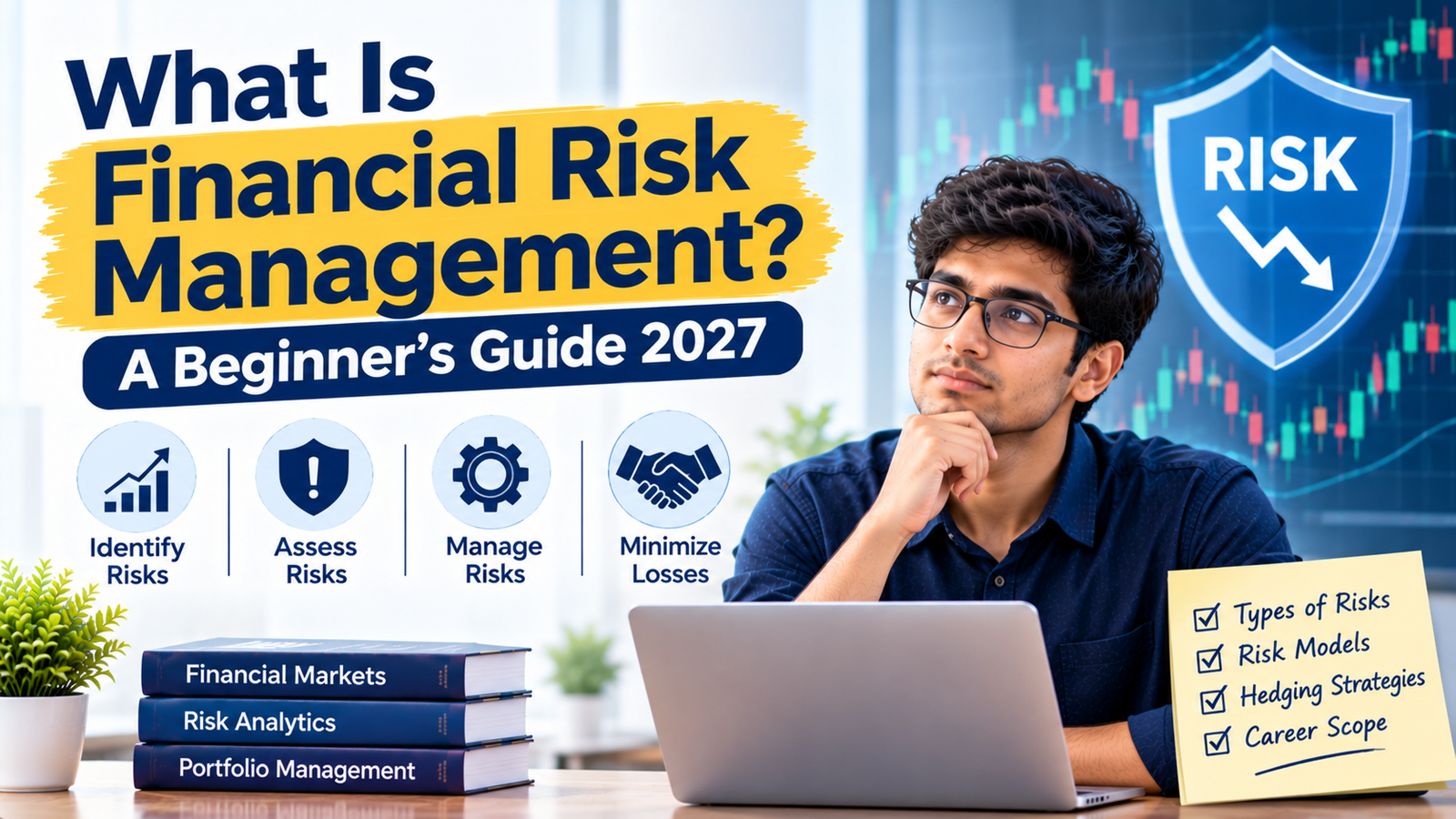
What Is Financial Risk Management?
Financial Risk Management is the process of identifying, measuring, analysing and controlling financial risks that may affect a company’s profitability, investments or financial stability.
Banks, investment firms, insurance companies and businesses face several uncertainties, including market fluctuations, loan defaults, interest rate changes and liquidity shortages.
For students and aspiring finance professionals, understanding financial risk management can open opportunities in banking, investment management, financial analysis and risk consulting.
1. Why Is Financial Risk Management Important?
Financial risks are present in almost every financial decision. A bank lending money, an investor purchasing shares or a company borrowing funds all face potential financial uncertainties.
Financial risk management helps organisations:
- Protect financial assets: Identify potential threats that could result in losses.
- Improve decision-making: Evaluate risks before making investments or lending decisions.
- Maintain liquidity: Ensure sufficient funds are available to meet financial obligations.
- Manage market exposure: Understand the impact of changing interest rates, currency values and stock prices.
- Strengthen financial stability: Prepare for unexpected economic and market conditions.
- Meet regulatory requirements: Establish appropriate risk controls and reporting processes.
For example, before approving a large business loan, a bank evaluates the borrower’s repayment capacity, financial position and credit history. This is an application of financial risk management.
2. What Are the Different Types of Financial Risks?
Understanding the major types of financial risks is the foundation of risk management.
A. Market Risk
Market risk arises when changes in market conditions affect the value of investments or financial positions.
It includes:
- Equity price risk
- Interest rate risk
- Foreign exchange risk
- Commodity price risk
Example: An investor holding shares may experience losses when stock market prices decline.
B. Credit Risk
Credit risk is the possibility that a borrower or counterparty may fail to meet its financial obligations.
Example: When a customer fails to repay a bank loan, the bank faces credit risk.
Financial institutions use credit assessment, credit scoring and exposure monitoring to manage this risk.
C. Liquidity Risk
Liquidity risk occurs when an organisation cannot meet its financial obligations when they become due, or cannot sell an asset quickly without a significant loss.
Example: A bank may face liquidity pressure if a large number of depositors withdraw their money within a short period.
D. Operational Risk
Operational risk arises from failures in internal processes, systems, people or external events.
Examples include:
- Internal fraud
- Cybersecurity incidents
- Technology failures
- Human errors
- Process breakdowns
E. Interest Rate Risk
Interest rate risk occurs when changes in interest rates affect the value of financial assets, liabilities or future cash flows.
Example: When market interest rates rise, the market value of existing fixed-rate bonds generally falls.
F. Foreign Exchange Risk
Foreign exchange risk arises when currency movements affect international transactions, investments or business earnings.
Example: An Indian company importing goods from the United States may face higher costs if the US dollar appreciates against the Indian rupee.
3. How Does the Financial Risk Management Process Work?
Organisations follow a systematic process to identify and manage financial risks.
Step 1: Risk Identification
Identify possible risks that could affect the organisation, such as market volatility, loan defaults or liquidity shortages.
Step 2: Risk Assessment
Evaluate the likelihood of each risk occurring and the potential financial impact.
Step 3: Risk Measurement
Use quantitative techniques, financial data and risk models to estimate potential exposure.
Step 4: Risk Mitigation
Develop strategies to reduce or manage identified risks. These may include diversification, hedging, credit limits and internal controls.
Step 5: Risk Monitoring and Reporting
Continuously monitor risk exposure, review performance and report significant changes to management.
The process is continuous because financial markets, regulations and business conditions keep changing.
4. Financial Risk Management Tools and Techniques
Financial professionals use different quantitative tools and techniques to measure financial exposure.
| Tool | How it is used |
|---|---|
| Value at Risk (VaR) | Estimates potential portfolio loss over a specified period and confidence level |
| Stress Testing | Evaluates how a portfolio or institution may perform under severe conditions |
| Scenario Analysis | Studies the impact of different possible market situations |
| Sensitivity Analysis | Measures how changes in variables affect financial outcomes |
| Credit Scoring | Evaluates the creditworthiness of borrowers |
| Hedging | Uses financial instruments to reduce exposure to specific risks |
| Duration Analysis | Measures the sensitivity of fixed-income instruments to interest rate changes |
Practical Example: Understanding Value at Risk (VaR)
Suppose a bank has an investment portfolio worth ₹10 crore.
Its risk model estimates a one-day Value at Risk of ₹20 lakh at a 95% confidence level.
This means that, under the model’s assumptions, the estimated loss should not exceed ₹20 lakh on approximately 95% of trading days.
However, VaR does not measure the maximum possible loss. Actual losses can exceed this estimate, especially during extreme market conditions.
This is why financial institutions also use stress testing and scenario analysis.
5. Role of Financial Risk Management in Banking
Banks are among the most important users of financial risk management because they manage deposits, loans, investments and financial transactions.
Consider a bank that provides thousands of personal and business loans.
It must evaluate:
- Whether borrowers can repay their loans.
- How interest rate changes affect its earnings.
- Whether sufficient liquidity is available.
- How market fluctuations affect its investment portfolio.
- Whether internal systems and processes are operating securely.
Risk management frameworks help banks monitor these exposures and establish suitable controls.
Financial risk management is also important in insurance companies, mutual funds, asset management firms, investment banks and large corporations.
6. What Is FRM Certification?
The Financial Risk Manager (FRM) certification is a globally recognised professional qualification offered by GARP (Global Association of Risk Professionals).
It is designed for individuals interested in developing specialised knowledge of financial risk measurement, analysis and management.
The FRM programme consists of two examination parts:
FRM Part I
Part I focuses on the fundamental tools and concepts used to assess financial risk.
It covers four major subjects:
- Foundations of Risk Management
- Quantitative Analysis
- Financial Markets and Products
- Valuation and Risk Models
FRM Part II
Part II focuses on applying risk management knowledge to real-world financial situations.
It covers:
- Market Risk Measurement and Management
- Credit Risk Measurement and Management
- Operational Risk and Resilience
- Liquidity and Treasury Risk Measurement and Management
- Risk Management and Investment Management
- Current Issues in Financial Markets
Candidates must pass both examinations and submit two years of relevant full-time professional work experience to earn the FRM certification.
For the latest syllabus, exam information and requirements, refer to the official GARP FRM Programme.
7. Why Choose FinOptions for FRM Training?
Understanding risk management concepts requires more than reading textbooks. Students need structured learning, conceptual clarity and consistent exam preparation.
At FinOptions Institute of Financial Studies, the FRM training programme is designed to help students and working professionals understand the FRM curriculum systematically.
What Does the FinOptions FRM Course Offer?
- FRM Part I and Part II preparation: Structured learning for both examination levels.
- Experienced trainers: Guidance from experienced finance educators.
- Concept-focused learning: Build a strong understanding of quantitative analysis, financial markets and risk models.
- Practical perspective: Connect theoretical concepts with financial industry applications.
- Career guidance: Understand relevant roles and career pathways in financial risk management.
- Finance-focused learning environment: Learn alongside students and professionals interested in finance careers.
FinOptions FRM Course Details
| Particulars | Details |
|---|---|
| Programme | Financial Risk Management (FRM) |
| Levels | Part I and Part II |
| Training | Structured FRM preparation |
| Mode | Contact FinOptions for current batch options |
| Fees | ₹35,000 + 18% GST per level, as listed on the course page |
Explore the FRM Course in Indore at FinOptions for programme details, fees and enrolment enquiries.
Whether you are a finance student, graduate or working professional, structured FRM preparation can help you build the knowledge required to understand financial risk management.
8. Career Opportunities After FRM
Financial risk management knowledge is relevant across banking, investment management, insurance and financial services.
Some career roles include:
1. Financial Risk Analyst
Identifies, measures and monitors financial risks affecting an organisation.
2. Credit Risk Analyst
Evaluates borrowers, loan applications and the possibility of credit defaults.
3. Market Risk Analyst
Monitors the impact of changes in stock prices, interest rates, currencies and other market variables.
4. Operational Risk Analyst
Identifies risks arising from internal processes, systems, people and external events.
5. Liquidity Risk Analyst
Monitors cash flow requirements and an organisation’s ability to meet financial obligations.
6. Risk Consultant
Helps organisations evaluate risk exposure and improve risk management frameworks.
7. Risk Manager
Oversees risk policies, monitoring systems and risk mitigation strategies.
The FRM qualification can support career development in these areas, although employment opportunities depend on experience, technical skills, qualifications and employer requirements.
9. Skills Required to Build a Career in Financial Risk Management
To develop a career in risk management, focus on building the following skills:
- Financial markets and products knowledge
- Quantitative and statistical analysis
- Probability and financial mathematics
- Financial statement analysis
- Risk measurement and modelling
- Advanced Excel
- Data interpretation and analytical thinking
- Communication and problem-solving
Knowledge of tools such as Excel, Python, SQL and data visualisation platforms can also be useful depending on the role.
You can strengthen your technical foundation through the Advanced Excel Course at FinOptions.
10. FRM vs CFA: Which One Should You Choose?
Both FRM and CFA are professional finance qualifications, but they focus on different areas.
| Basis | FRM | CFA |
|---|---|---|
| Main focus | Financial risk management | Investment analysis and portfolio management |
| Key subjects | Risk models, market risk, credit risk and quantitative analysis | Equity, fixed income, financial statement analysis and portfolio management |
| Career interests | Risk analysis, credit risk, market risk and treasury | Equity research, portfolio management and investment analysis |
| Exam structure | Two parts | Three levels |
| Awarding body | GARP | CFA Institute |
Which should you choose?
Choose FRM if you are interested in financial risk, banking risk, quantitative analysis and risk management.
Consider CFA if you are more interested in investment research, portfolio management, equity analysis and asset management.
Your choice should depend on your career interests and the type of finance work you want to pursue.
Conclusion
Financial risk management is an essential function in modern banking, investment management and corporate finance. It helps organisations identify uncertainties, measure financial exposure and make informed decisions.
From market risk and credit risk to liquidity and operational risk, understanding these concepts can help build a strong foundation for a career in financial services.
If you want to develop specialised knowledge in this field, the FRM certification can be a valuable learning pathway.
Take the next step towards your finance career with FinOptions.
Explore the FRM Course in Indore to learn about Part I and Part II preparation, course fees and enrolment opportunities.
FinOptions Institute of Financial Studies
Learn. Build Skills. Grow in Finance.
Frequently Asked Questions (FAQs)
1. What is financial risk management in simple words?
Financial risk management is the process of identifying, analysing and controlling risks that may cause financial losses to an individual, business or financial institution.
2. What are the five major types of financial risks?
The major types include market risk, credit risk, liquidity risk, operational risk and interest rate risk. Foreign exchange risk is another important category.
3. What is the difference between financial risk and business risk?
Financial risk generally relates to financial exposures such as debt, interest rates, credit and market movements. Business risk is broader and includes uncertainty arising from operations, competition, customer demand and business strategy.
4. What is the FRM certification?
FRM is a professional certification offered by GARP that focuses on financial risk management, quantitative analysis, financial markets and risk measurement.
5. Who can pursue FRM?
Students and working professionals interested in financial risk management can register for the FRM examinations. GARP does not require specific educational or professional prerequisites to register.
6. How many levels are there in FRM?
The FRM programme has two examination parts: FRM Part I and FRM Part II.
7. How much work experience is required for FRM certification?
Candidates must submit evidence of two years of relevant full-time professional work experience after passing both FRM examinations. The experience can be gained before or after passing the exams, subject to GARP’s requirements.
8. What are the career opportunities after FRM?
Career opportunities include Financial Risk Analyst, Credit Risk Analyst, Market Risk Analyst, Operational Risk Analyst, Liquidity Risk Analyst and Risk Consultant.
9. Is FRM better than CFA?
Neither qualification is universally better. FRM focuses on financial risk management, while CFA focuses more broadly on investment analysis and portfolio management. The right choice depends on your career goals.
10. Where can I pursue FRM training in Indore?
You can explore the FRM training programme at FinOptions Institute of Financial Studies for information about Part I and Part II preparation, fees and enrolment.